Five columns hold four visible card positions each
The publisher’s Main Game image shows five vertical columns and four complete card positions in each column. The cards fill a portrait display beneath a horizontal multiplier bar. This gives the pictured main field twenty complete positions; it is a description of the published image rather than an assumption borrowed from a different Ace title. [super-ace-promo-2]
Several symbol families are visible at once. The image contains the four familiar suit shapes, lettered Ace cards and illustrated Jack, Queen and King cards. Some cards have gold backgrounds, while others sit on pale backgrounds. A coin bearing the word SCATTER is visually separate from the ordinary card faces. These distinctions help a reader name what is actually on the display without treating all bright symbols as the same feature.
The artwork uses card imagery, but the image does not depict a dealt poker hand. Twenty visible positions on a slot field serve a different purpose from five cards held for a poker comparison. Nothing in the supplier’s product paragraph instructs readers to apply poker hand rankings to those positions. The title’s card theme should therefore remain separate from assumptions about another game’s scoring system.
A winning gold card becomes a Wild at its location
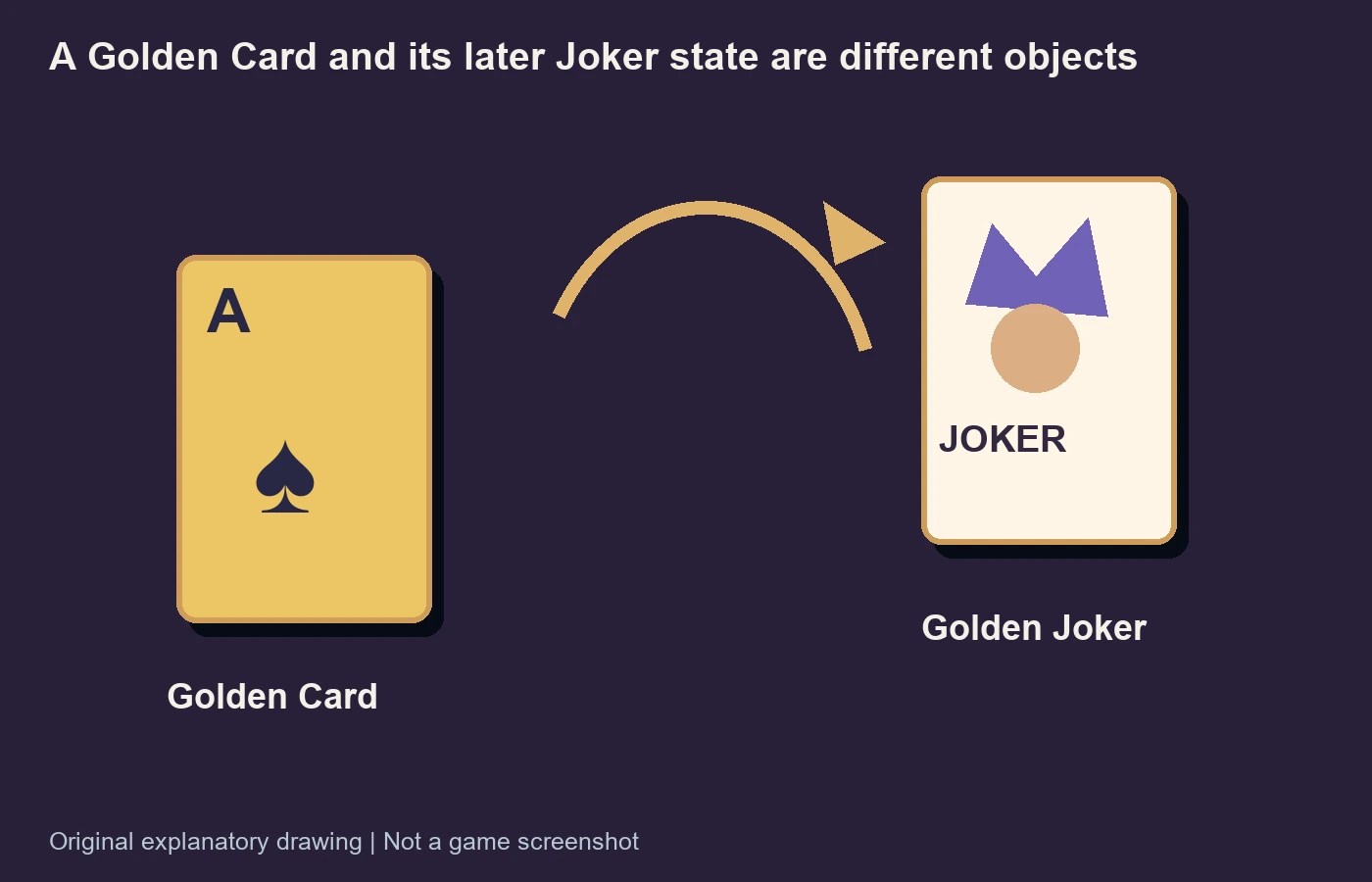
JILI’s product text says a Golden Joker appears after a Golden Card is eliminated. The Loading Page image adds a useful location detail: its feature panel explains that a winning golden card turns into a Wild in the same place. The transformation therefore concerns the state of a particular position, not a gold card moving somewhere else in the field. [super-ace][super-ace-promo-1]
The publisher depicts the later Wild with a jester-style emblem and the word WILD. In its Main Game promotional sequence, several Wild emblems appear over different card positions while a COMBO label is visible above the field. Our original pair of card objects isolates that earlier gold-card and later Joker relationship; it does not reproduce the publisher’s jester artwork. [super-ace-promo-2]
A caption can make the transition precise by naming both the prior object and its later location state. Calling the gold card a Wild before the documented change would erase the sequence. Conversely, describing the later Joker merely as another gold card would miss the feature. The available promotional text does not provide a complete substitution-exception table, so no claim about every possible replacement is added here.
Main-game and free-game bars show different progressions
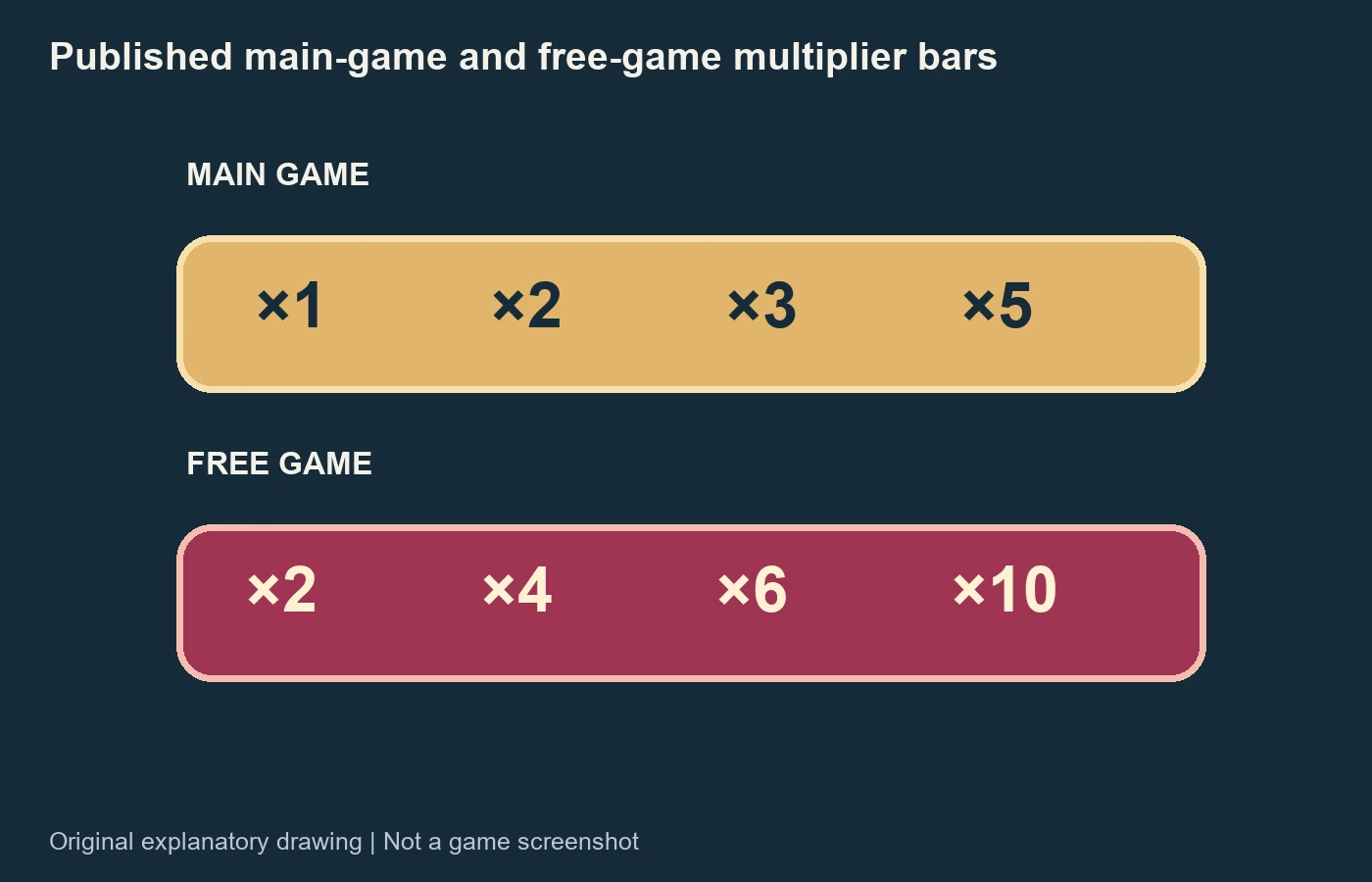
The Main Game promotional image prints four values across its top bar: one, two, three and five times. A frame at the beginning highlights one, while another frame with a later COMBO label highlights five. These are visible main-game feature states in the published material, not values inferred from a community video. [super-ace-promo-2]
The Free Game image changes the bar to two, four, six and ten times. Those values correspond pairwise to twice the main-game values: two corresponds to one, four to two, six to three and ten to five. This is consistent with the product paragraph’s statement that free-game multipliers double the main-game multipliers. The original explanatory meter uses those documented labels. [super-ace-promo-3][super-ace]
The two bars should be read as phase-specific displays. A ten-times highlight belongs to the pictured free-game bar; it should not be attached to the main-game bar just because both occupy a similar place above the cards. Likewise, the product page’s separate 10,000-times maximum is not another stage on either four-value bar. The bar, the total result field and the advertised ceiling are three different categories of number.
The Loading Page image associates increasing elimination combinations with the increasing bar values. It supplies the feature’s visual direction, while the Main Game and Free Game images identify the values shown in their respective phases. The full reset and substitution conditions still require the applicable rules; the promotional frames do not justify manufacturing missing clauses. [super-ace-promo-1]
Free-spin counters are separate from the highlighted multiplier
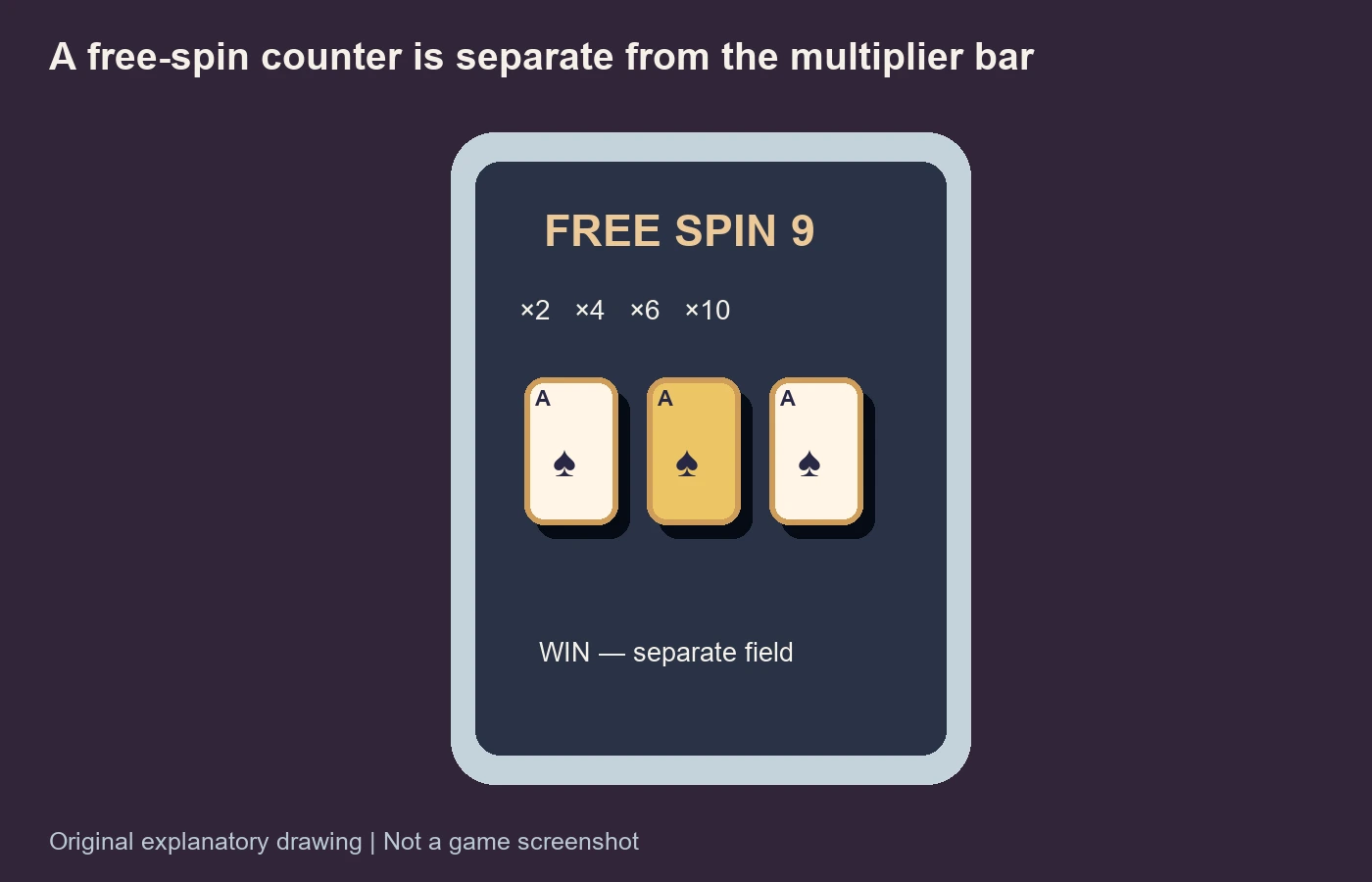
The Free Game material includes frames labelled FREE SPIN 9 and FREE SPIN 8 above the red multiplier bar. The counter changes while the bar still contains the same four factor labels. This makes the information hierarchy visible: the counter identifies remaining feature play, while the highlighted bar value identifies the factor state shown in that frame. [super-ace-promo-3]
The Loading Page montage also contains a feature-introduction panel displaying ten spins. In the Free Game montage, another panel displays an award of five free spins alongside several Scatter coins. These are published feature examples. A still montage does not establish every entry or retrigger condition, so the pictured counts are not rewritten into a universal scatter schedule. [super-ace-promo-1][super-ace-promo-3]
This distinction is useful on a small display. The counter sits above the factor bar, the symbol field occupies the centre and the WIN field sits below it. Reading top to bottom keeps a remaining-spin count from being confused with a multiplier or a credited amount. The original counter illustration keeps those labels apart without pretending to be a screen captured during our access attempt.
The lower controls do not belong to the card field
The publisher’s Main Game and Free Game materials show a bottom interface area containing WIN, a bet field, Balance, a central circular control and smaller settings or sound controls. Those labels remain below the playing-card positions. A picture cropped to the cards can therefore explain a symbol arrangement while omitting the separate financial and control context. [super-ace-promo-2][super-ace-promo-3]
Some panels show a circular-arrow control and others a square stop-style control. We report these as visible differences between promotional frames, rather than claim that a particular button was pressed in our check. Similarly, balances and result amounts in the supplier’s material are promotional examples, not this publication’s account history. We do not use their values to calculate returns or claim successful play.
The promotional footer prints a build-style identifier, 0.089 1699. That is kept as an image-specific observation. It is not silently equated with the V.1 label in PAGCOR’s dated JILI game-approval register, because the two sources use different identifiers and do not explain the relationship between them. [super-ace-promo-2][super-ace-promo-3]
ID 49 is a historical identity record, not demo access
PAGCOR’s JILI game-approval register dated 20 November 2025 records SUPER ACE on page five, row 179, as ID 49, V.1, type Slot. The JILI product URL also identifies the unsuffixed Super Ace page with 49. Together they support a careful title identification, while the unavailable demonstration leaves its actual current build unconfirmed. [pagcor-jili][super-ace]
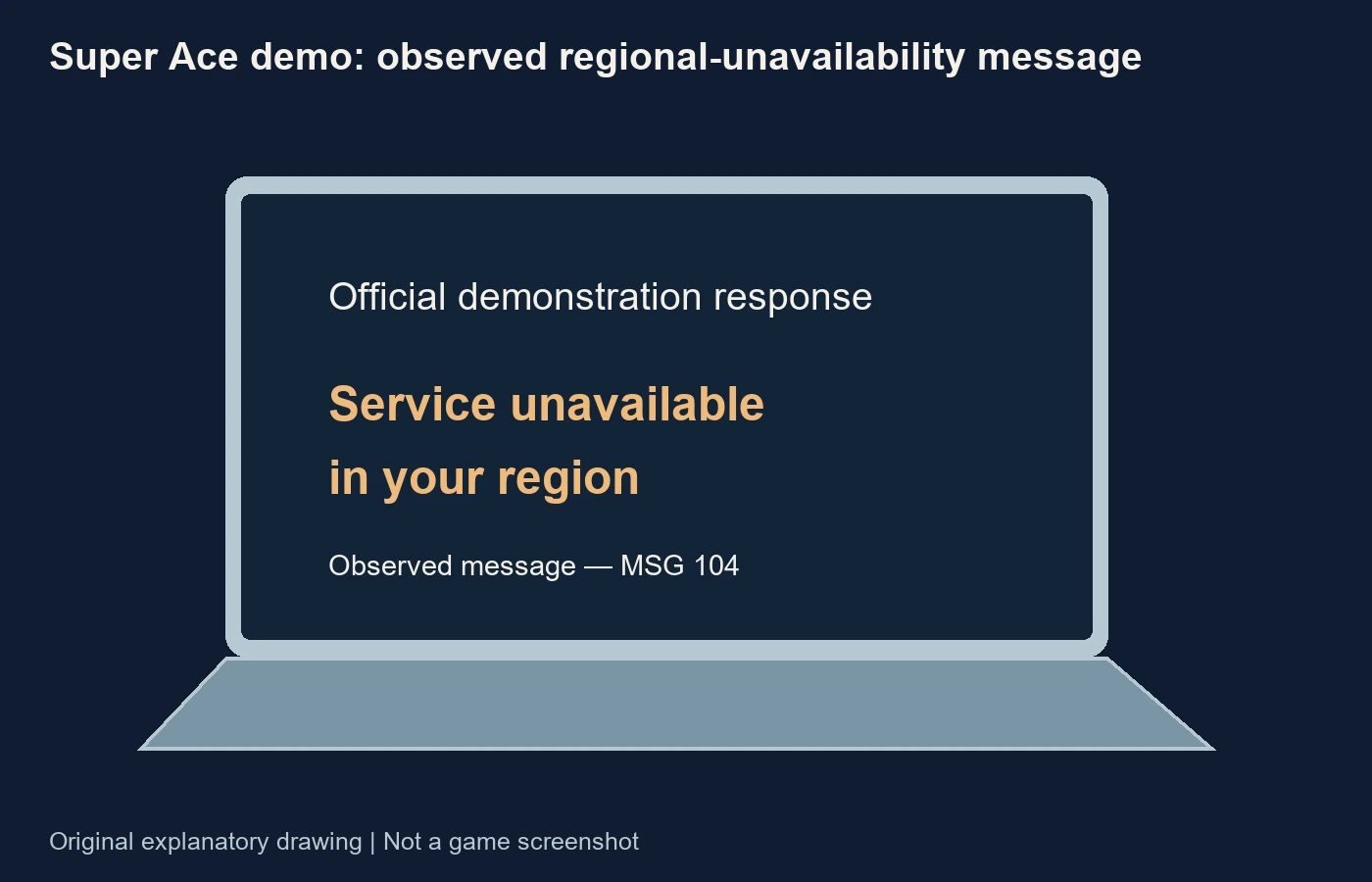
JILI’s product page separately lists 1,024 ways, the LOW-MED volatility label and a maximum of 10,000 times. They are dated supplier descriptors, not a probability calculation or a promise about a session. The named promotional images supply the concrete layout and feature-display examples used above. The failed access screen supplies only the observed MSG 104 response; no playable demonstration, local operator authorisation or gameplay test is claimed. [super-ace][super-trial]
Reader questions
- Is the Super Ace demo confirmed playable here?
- No. The official destination returned Service unavailable in your region, MSG 104, in our recorded check. This page provides no alternative route or playable client, and the observation does not establish what every country or device will receive.
- What changes from Golden Card to Golden Joker?
- JILI says the Golden Joker appears after the Golden Card has been eliminated. We illustrate those as separate states. The short public description does not supply a complete substitution-exception table, and none is invented here.
- Does double multipliers mean double session returns?
- The official main-game and free-game materials show different factor bars, and the product paragraph describes doubled free-game multipliers. That relationship alone does not predict a session return or supply a complete payout calculation.
- What does version V.1 establish?
- It is the historical version label paired with game ID 49 in the PAGCOR JILI game-approval register dated 20 November 2025. It does not verify the current demonstration build, an operator’s domain or present availability.