REEL VOLT / JILI SINGLE-TITLE FILE

Fortune Gems 3: Board, Split Symbols and Multipliers

By Reel Volt source desk · Updated 2026-11-05 · Published 5 November 2026 · Remit: JILI product references, original explanatory drawings and dated source records.

Fortune Gems 3 presents a compact gem field beside a separate Win Multiplier strip, with symbol splitting that the publisher says can form more connections. JILI’s product page and its official Loading Page and Game Feature images document these distinct parts of the presentation. PAGCOR’s separate record identifies the title as ID 300, V.1, as of 20 November 2025; the historical JILI game-approval register supplies identity rather than the feature rules. [fortune-gems-3][fortune-gems-3-promo-1][fortune-gems-3-promo-2][fortune-gems-3-promo-3][pagcor-jili]

The compact board and the multiplier strip are separate areas
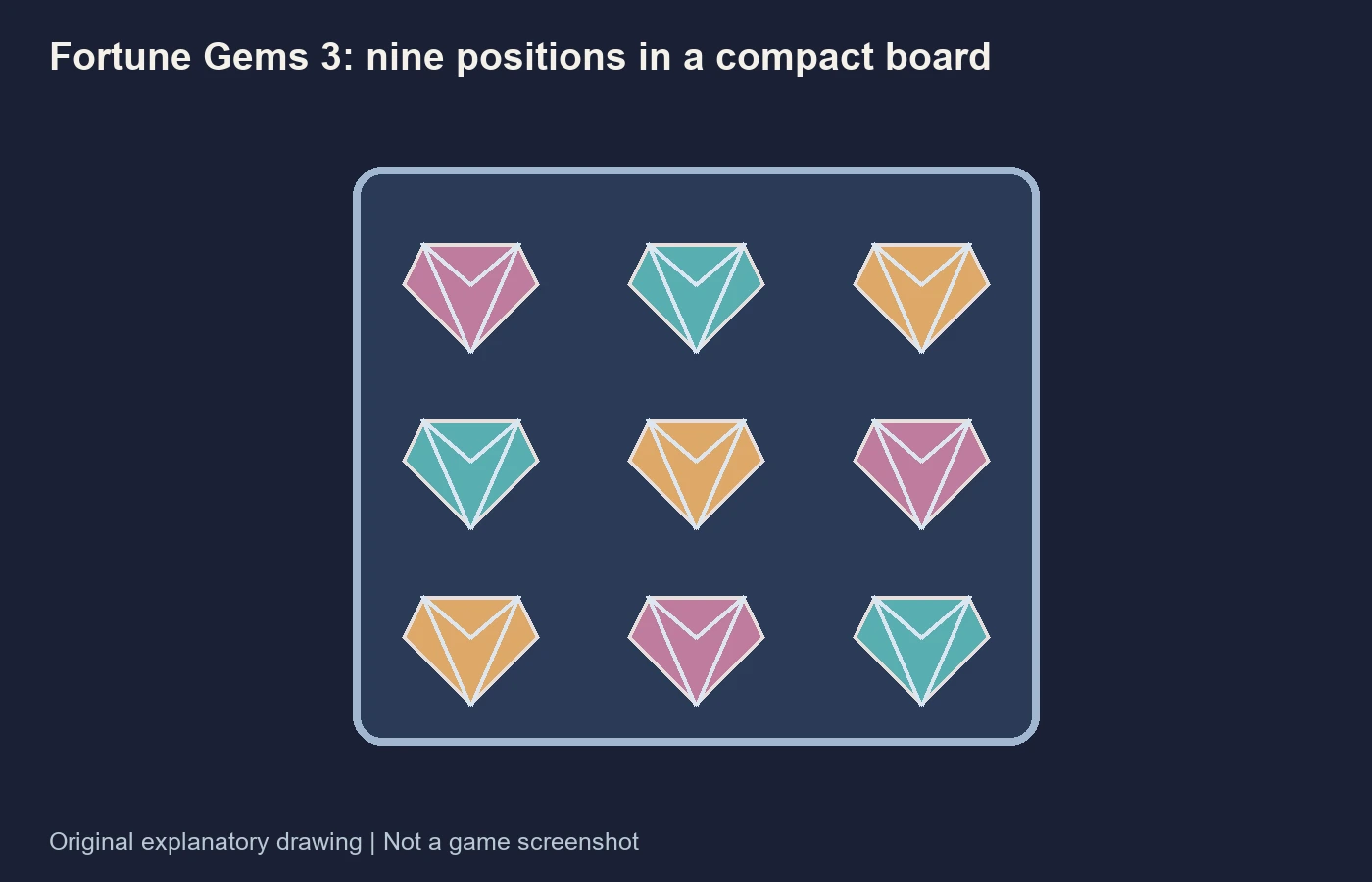
A three-by-three conceptual reel frame contains nine original faceted gems in three rows and three columns.
The nine visible positions explain the supplier’s compact three-by-three format without reproducing official artwork. Original illustration.

JILI’s product description names a three-by-three board and five lines. In the publisher’s Game Feature image, the gem field sits on the left, while a narrower vertical panel labelled WIN MULTIPLIER sits on the right. Those two areas have different jobs: one presents symbol arrangements and the other presents the factor associated with the depicted event. [fortune-gems-3][fortune-gems-3-promo-3]

The image’s temple-style frame makes this separation particularly clear. Three broad symbol columns occupy most of the width, while the factor panel contains three circular value markers stacked vertically. A bright rectangular frame surrounds the middle factor in the pictured event. The layout therefore gives a reader more context than a close-up of an isolated jewel would supply.

The original board illustration keeps the compact field visible without copying JILI’s artwork. Its nine positions explain the basic three-by-three description. The later split-symbol illustration has a different purpose: it explains subdivisions within a symbol position, rather than claiming that the ordinary board began as six or nine fully separate rows. The product’s base format and its split presentation should not be merged into one unexplained count.
Splitting can create more symbol connections

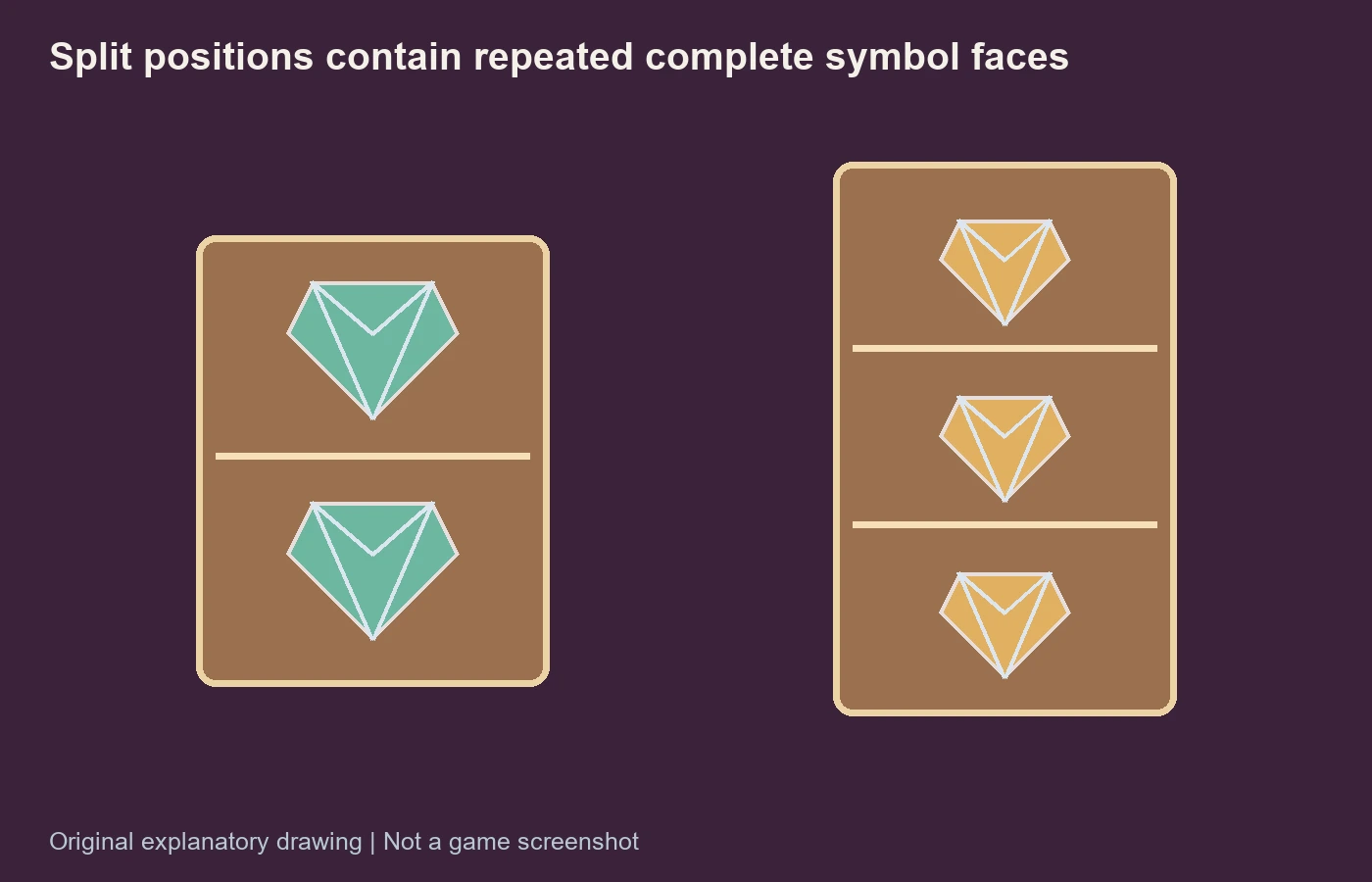
Two divided conceptual symbol positions contain two green gem faces and three gold gem faces, keeping each repeated face complete.
The split-position drawing illustrates repeated whole symbol faces, as seen in the publisher’s split examples, rather than unrelated rock shards. Original illustration.

The publisher’s Loading Page image explicitly says that split symbols can form more connections. Its illustration depicts several small matching golden figures stacked inside positions. A separate Game Feature image shows green-gem positions divided horizontally into two complete gem faces. These materials support the qualitative connection between splitting and additional matching opportunities. [fortune-gems-3-promo-1][fortune-gems-3-promo-3]

The pictured effect is subdivision with repeated symbol faces, rather than a rock breaking into unrelated shards. This matters for the explanation. A cracked-jewel drawing would suggest destruction of an object, whereas the official material shows more symbol faces occupying the split presentation. The original illustration therefore uses divided positions containing complete gem shapes, not generic broken fragments.

The promotional material shows more than one subdivision appearance. The golden-figure example includes three stacked faces in a position, while the green-gem example includes two. Those are observations of the supplier’s examples, not a newly invented probability distribution or every possible split state. The images do not provide a full trigger table for when a particular subdivision occurs.

The five-line label does not erase the split feature

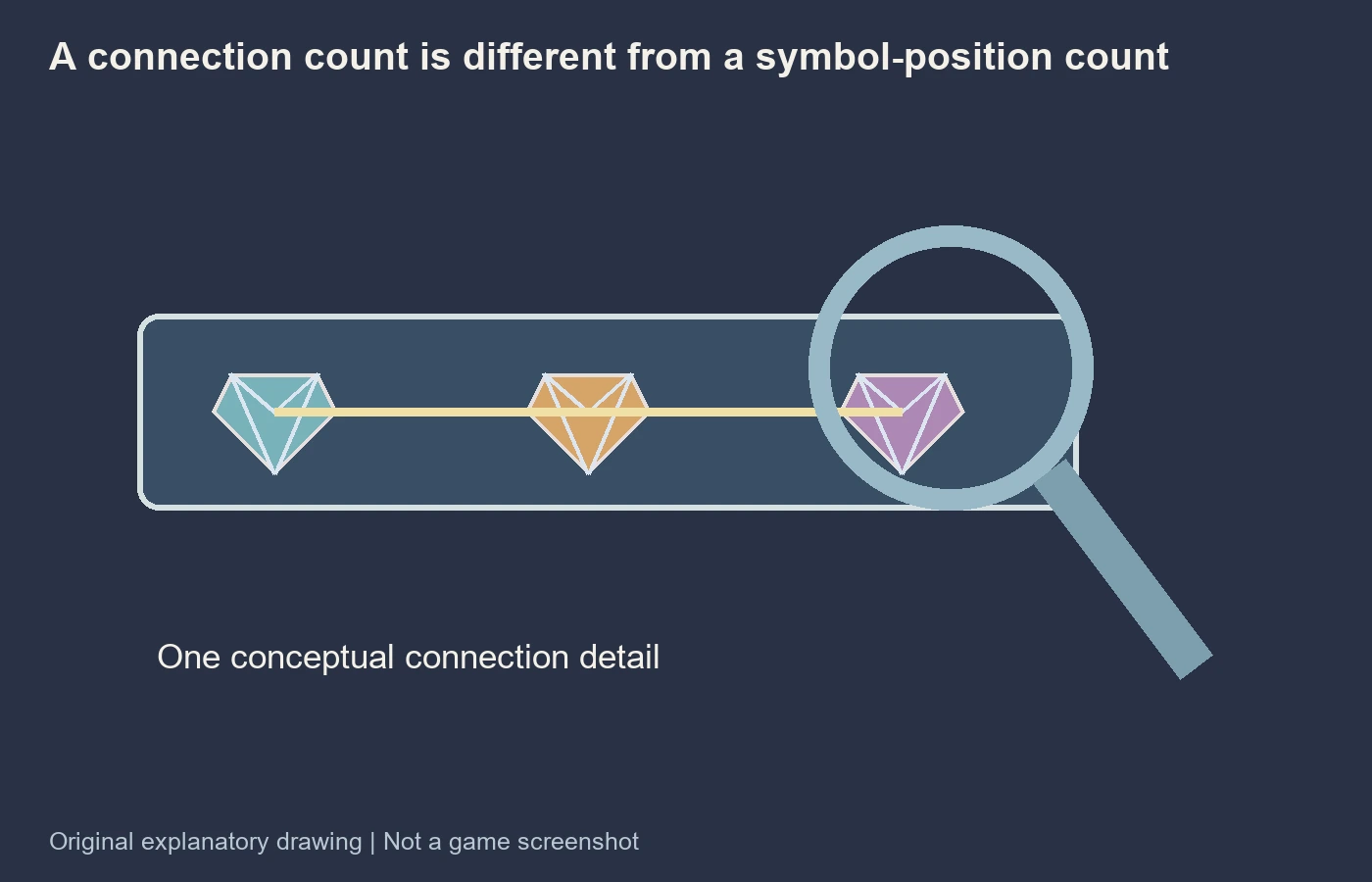
A magnifying glass focuses on one conceptual connection across three jewel objects in a cropped reel-style strip.
The connection detail separates the evaluation relationship from the number of visible base positions; it is not a complete route map. Original illustration.

The structured product field lists five lines, and its feature bullets also mention five connections. That is the basic published label for the title. The separate promotional statement about splitting explains why the feature discussion should not stop at the static line count. The title combines a compact base description with a visible subdivision feature. [fortune-gems-3][fortune-gems-3-promo-1]

A reader can therefore keep two questions apart. One concerns the product’s named evaluation format; the other concerns what the split-symbol presentation changes in the feature example. Drawing an invented complete route map would not answer either question reliably, because the public material does not enumerate all route conditions. Our connection close-up isolates the idea of a relationship across symbols without pretending to reproduce the official paytable.

Counting the number of green gem faces in a split promotional frame also does not establish how many awards were credited. The frame contains symbol artwork, a factor panel and an event amount, but a complete settlement calculation would require the underlying values and rules. This reference explains the visible feature relationship without reconstructing an unseen paytable.

The highlighted factor belongs to a separate display

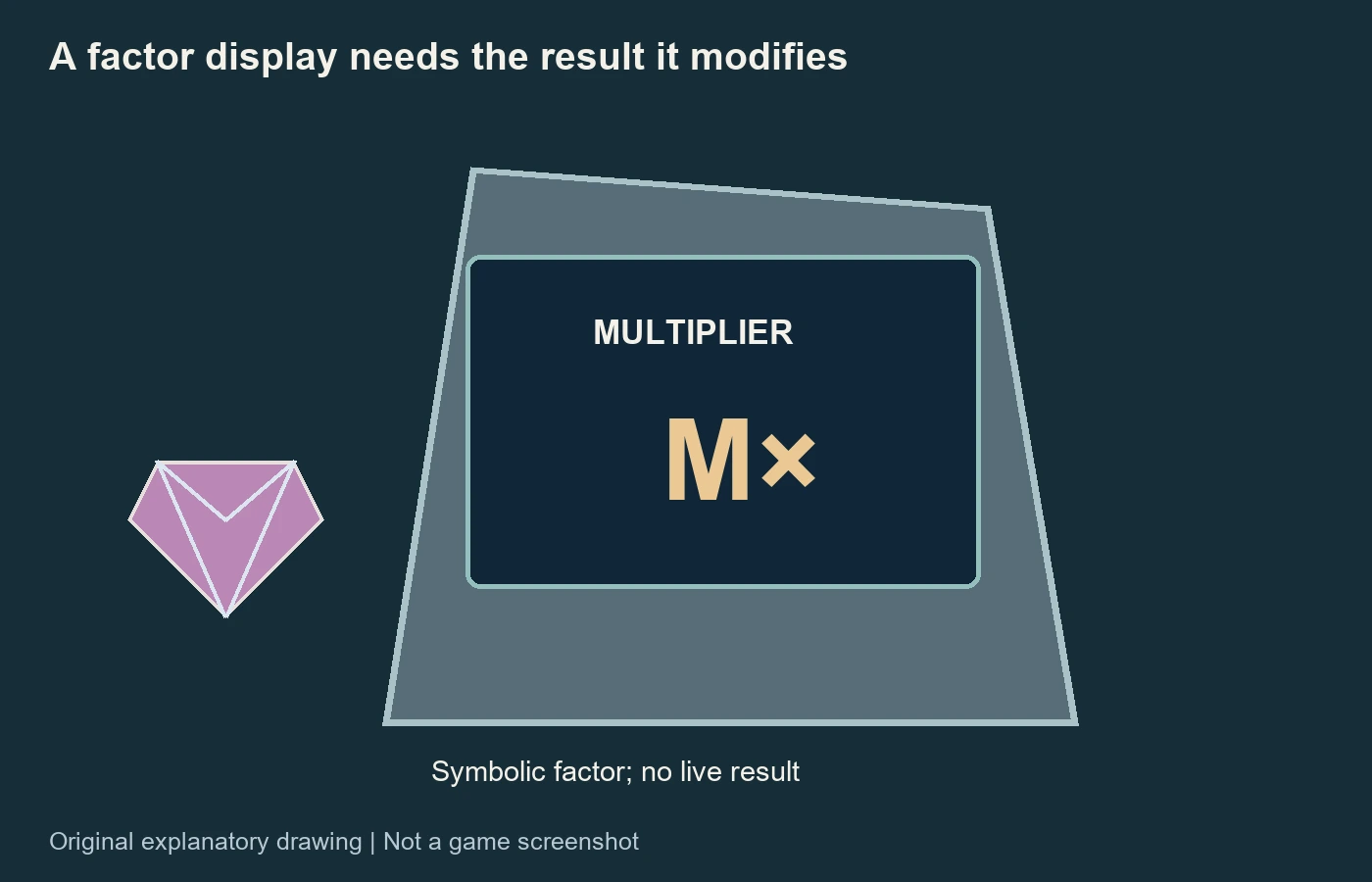
A physical-style arcade cabinet displays a symbolic M-times factor beside a separate jewel on a pedestal.
The factor display and jewel are separate objects, showing why a visible multiplier needs an underlying result for an amount. Original illustration.

The second Loading Page image states that a win can receive multiplier rewards and shows a highlighted 15-times marker in the right-hand strip. The Game Feature image separately highlights three times. These are published factor examples from the title’s own materials. They are not measurements collected during a played session by this publication. [fortune-gems-3-promo-2][fortune-gems-3-promo-3]

In the three-times image, the markers immediately above and below the highlighted middle position both show one. In the 15-times example, other visible markers include five and ten. The changing visible neighbours show why a single frame should not be treated as a complete ordered factor schedule. The selected marker and the surrounding visible markers have to remain distinct.

Our physical-style cabinet illustration isolates the factor display from a separate gem object. It explains that a multiplier label is not itself the symbol combination. The factor still needs the applicable result to produce an amount. We do not import a factor range from another Fortune Gems release or infer how often one displayed marker is selected.

Garuda artwork identifies the gold-symbol presentation

JILI’s product paragraph names Garuda, and its later Game Feature image fills much of the symbol area with stacked golden figures. A separate Super Win asset shows gold bird imagery around the result overlay. These are recognisable subjects in the title’s own visual presentation, rather than generic coins supplied by an unrelated website. [fortune-gems-3][fortune-gems-3-promo-4][fortune-gems-3-promo-5]

The distinction between a golden figure and a coloured gem helps a reader describe the publisher’s split examples precisely. Both can appear in subdivided positions in the materials, but they are different pictured symbol subjects. Referring to every object simply as a jewel would lose that visual difference. It would also make the gold-heavy feature frame harder to distinguish from the green-gem frame.

The product paragraph uses promotional language about a full Garuda board. We retain the observed artwork and the feature name without repeating its promise as a general financial guarantee. The large amounts printed in the promotional examples remain publisher examples. They are not our results, an estimate of likely earnings or evidence that a reader will encounter the same arrangement.

Balance, WIN and the result overlay belong to different fields

The lower interface in the official Game Feature images has separate Balance, bet and WIN labels. A large result overlay can appear above them while the symbol field and the selected factor remain visible behind it. These locations help identify what a crop includes and what it leaves out. An isolated overlay amount cannot reconstruct the entire event. [fortune-gems-3-promo-3][fortune-gems-3-promo-4][fortune-gems-3-promo-5]

The materials also show an information control near the upper-left area, a lower settings symbol and other control artwork around the base. Their visible presence explains the interface composition. The promotional stills do not establish that every control behaves identically across deployments, and this article supplies no instructions for changing stake or activating play.

The product page lists a ceiling of 10,125 times and a HIGH-MED volatility label, while the first Loading Page image prominently repeats 10,125 times. We report those as supplier statements for the named release. No RTP figure appears in the retrieved product text, and no hit frequency is calculated from the split examples. [fortune-gems-3][fortune-gems-3-promo-1]

Preserve the dated identity of the named release

Page three, row 89 of PAGCOR’s JILI game-approval register identifies FORTUNE GEMS 3, ID 300, V.1 and type Slot as of 20 November 2025. It distinguishes the named title without supplying the multiplier or split rules. Those descriptions above come from JILI’s own product and promotional materials, with each claim tied to its particular image or text. [pagcor-jili]

This guide therefore covers the documented field, split-symbol examples, factor strip and pictured interface of Fortune Gems 3. It does not transfer features from another numbered release, establish an operator’s current permission or claim that the promotional frames are captures of a live client examined by this publication.

Reader questions

How large is the documented board?
JILI describes a three-by-three board and labels the game with five lines. Nine visible positions and five lines are different kinds of count. The illustration explains the layout without inventing every route in the full paytable.
Does the split drawing state the actual feature output?
The publisher’s promotional examples show divided positions containing repeated complete symbol faces, including two-part gem and three-part gold-symbol examples. Our artwork explains that visual distinction without claiming a complete trigger table or distribution.
Is 10,125 times an expected outcome?
No. It is the maximum shown on the retrieved JILI product page. We report it as a supplier descriptor for the named release, not as measured performance, a probability or a typical-session estimate.
Does the PAGCOR JILI approval register explain Fortune Gems 3 rules?
No. The dated JILI game-approval register identifies the title as ID 300, V.1 and type Slot. It supports a historical identity record, while the mechanism descriptions come from JILI’s separate product page.